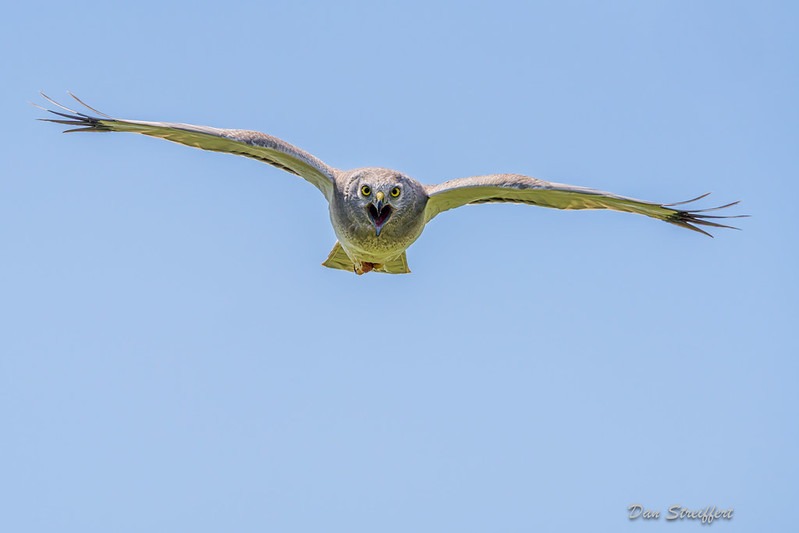
Northern Hairier
By Dan Streiffert


by Barbara Petersen
Hello and welcome back to my musings!
I always enjoy watching the little House Sparrows that hop around on the sidewalk under the seed feeder in front of the store. I’m sure many of you enjoy watching birds in your yards as well. I thought it would be fun, with a little help from our friends at Cornell Lab of Ornithology, to share some facts about birds often seen in yards and at feeders.
Although some of us may have never seen one, Mourning Doves are very common in parts of our beautiful state. Mourning Doves can store seed in an enlargement of the esophagus called the crop. One dove set a record by storing 17,200 seeds in its crop! Once the crop is full the bird flies to a perch to digest its meal. Mourning Doves eat 12-20% of their body weight per day. The oldest recorded Mourning Dove lived to be 31 years, 4 months old.
Dark-eyed Juncos are among the most populous birds with an estimated 630 million individuals across North America. The oldest recorded Junco lived to be 11 years, 4 months old.
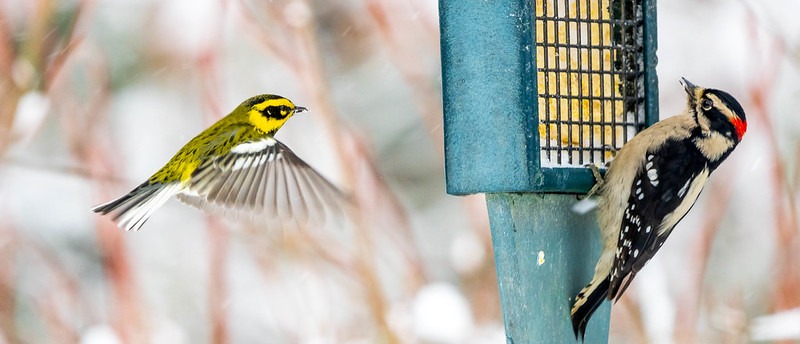
In winter Downy Woodpeckers divide their feeding areas, with males feeding on small branches and weed stems and females on larger branches and tree trunks. The oldest recorded Downy lived to be 11 years, 11 months old.
The American Goldfinch is the only finch that molts its body feathers twice a year, once in late winter and again in late summer. American Goldfinches are the strictest of vegetarian birds, eating only an occasional insect. Paired American Goldfinches make identical flight calls. The oldest recorded American Goldfinch lived to be 10 years, 5 months old.
The House Finch has a huge presence in North America, with scientists estimating between 267 million and 1.4 billion individuals. House Finches feed their nestlings plant food exclusively which is rare in the bird world. The oldest recorded House Finch lived to be 11 years, 7 months old.
Black-capped Chickadees hide seed and other food items in a variety of different locations. They can remember thousands of hiding places. Adult Black-capped Chickadees always sleep in individual cavities. The oldest recorded Black-capped Chickadee lived to be 12 years, 5 months old.
The Red-breasted Nuthatch stays here all year but northern populations migrate south very early, possibly beginning in early July especially during irruptive years. Red-breasted Nuthatches will steal nesting material from other birds. The oldest recorded Red-breasted Nuthatch lived to be 7 years, 6 months old.
House Sparrows were introduced to Brooklyn, New York, in 1851. House Sparrows love to take dust baths. The oldest recorded House Sparrow lived to be 15 years, 9 months old.
Although American Robins are thought of as harbingers of spring, many spend the winter months in their breeding range. The oldest recorded American Robin lived to be 13 years, 11 months old.
A House Wren weighs as much as two quarters. House Wrens nest in tree holes or nest boxes and sometimes incorporate spider egg sacs into the nesting material. When the spiderlings hatch they devour mites and other parasites that can harm the wren nestlings. The oldest recorded House Wren lived to be 9 years old.
The Bewick’s Wren is named after British engraver Thomas Bewick who was a friend of John James Audubon. The oldest recorded Bewick’s Wren lived to be 8 years old.
Northern Flickers love to eat ants and forage on the ground for them. Flickers often drum on metal, making the loudest noise possible to communicate and defend territory. The oldest recorded Northern Flicker lived to be 8 years, 9 months old.
A group of Anna’s Hummingbird is not called a flock. More appropriately the terms bouquet, a glittering, a hover, a shimmer or a tune of hummingbirds is used. Indigenous Americans thought that hummingbirds poked holes in the night sky and the holes became the stars. An Anna’s Hummingbird’s body temperature is 107 degrees. The oldest recorded Anna’s lived to be 6 years, 4 months old.
The Steller’s Jay is the only North American jay with a crest. Steller’s Jays use mud to bind nest materials together. They are excellent mimics. The oldest recorded Steller’s Jay lived to be 16 years, 1 month old.
The Bushtit is the only member of its family in the Americas. Seven species are found in Eurasia. When breeding only one adult Bushtit at a time sleeps on the nest, but in non-breeding season all of the Bushtit family members sleep together in their small, hanging nest. The young of the first brood will help feed the young of a second brood in a successful breeding season. The oldest recorded Bushtit lived to be 9 years, 1 month old.
A White-crowned Sparrow was tracked to have traveled 300 miles in a single night. Although male White-crowns are the dominant singers, the females sometime sing a quieter and more variable song. The oldest recorded White-crowned Sparrow lived to be 13 years, 4 months old.
The Golden-crowned Sparrow is one of the least known of our songbirds. As days get longer in the spring, Golden-crowned Sparrows detect the change through light-sensitive cells and respond by putting on fat and getting an urge to migrate. The oldest recorded Golden-crown lived to be 10 years, 6 months old.
I’ve enjoyed sharing these fascinating tidbits about common birds with you. I hope you found these cool facts to be fun and educational.
Until next time,
Millie, the Muse of Mews