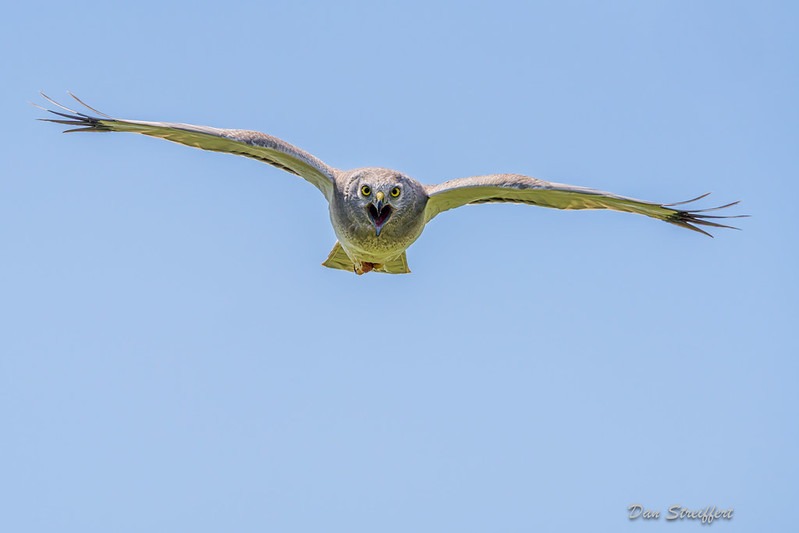
Northern Hairier
By Dan Streiffert


by Barbara Petersen
(Written by Pat Toth, shared by permission of the Burien Wild Birds Unlimited)

The Autumn Equinox has come and gone. Can you feel the change in the air? I learned on KPLU’s BirdNote that many ancient cultures closely watched the changes in the sun’s daily patterns. Many cultural legends regarding this involve birds. One legend from South America is that only the giant Andean Condor with its 10-11 foot wingspan had the strength to lift the sun each morning and drag it back down each evening. The Andean Condor is the national symbol of Argentina, Bolivia, Chile, Colombia, Ecuador and Peru.
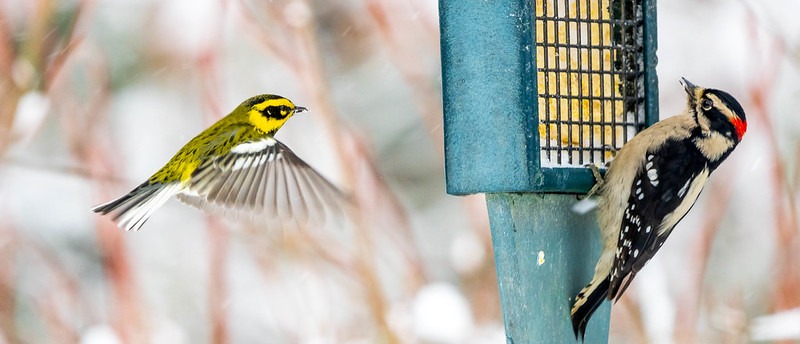
The most frequently asked question in the store these last few weeks has been “Where have all my goldfinches gone?” The American Goldfinch is a common resident in our region year around, although it may be more difficult to find them during the winter. They are nomadic so move around from place to place. After they finish nesting in late August or early September goldfinches molt their feathers. The new feathers that grow in are a somewhat drab olive-green color instead of bright yellow or gold. They might have a small bit of yellow on the face or throat. Look for the distinctive white wing bars on black wings and you’ll know that your goldfinches are still around.
Speaking of birds that stay here all year, you may know that our Anna’s Hummingbird does just that. Do you know who ‘Anna’ was? Some sources refer to her as Princess, others as Duchess of Rivoli, but Anna de Belle Messena was married to Victor Messena who had an extensive collection of bird specimens. John James Audubon went to Paris to visit the couple and was smitten by Anna’s charm and beauty. He later honored Anna by having Rene Primevere Lesson name the beautiful little bird after her, immortalizing her beauty forever in the name of our only overwintering hummingbird.
After sharing about the Civil War’s 43rd Ohio ‘Martin Box Regiment’ described in This Hallowed Ground, I was curious to find out if other birds had ‘made history’ and learned of the 77th Infantry Division, aka the Lost Battalion. During World War I they were trapped for six days in a hollow in the Argonne Forest. The commander, Major Charles Whittlesey, released three homing pigeons requesting aid but none made it through enemy lines. He had one homing pigeon left named Cher Ami. Despite heavy enemy fire Cher Ami flew twenty-five miles in twenty-five minutes. Cher Ami lost an eye and a leg but completed the flight, delivering the message with which he had been entrusted. The soldiers were saved! Cher Ami was considered a war hero and received the French Medal, the Croix de Guerre, a gold medal and a silver medal. Cher Ami died June 13, 1919, was preserved, and can still be seen today at the Smithsonian National Museum of American History.
You’ve probably heard of a ‘gaggle of geese’ or a ‘murder of crows’, but have you heard of a ‘charm of finches’ or a ‘stare of owls’? There are over 140 collective nouns used with birds. Until next time, enjoy watching and feeding the birds, and do not for a second believe that hummingbirds migrate on the backs of geese!
Millie, the Muse of Mewsby