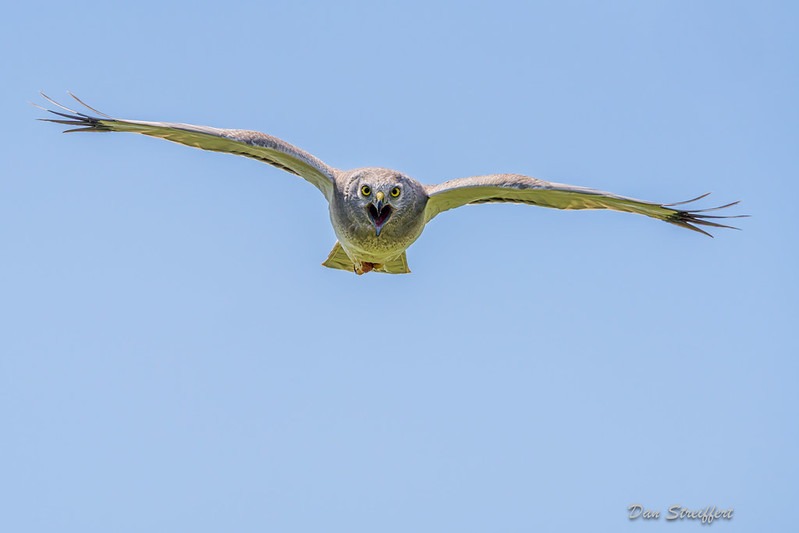
Northern Hairier
By Dan Streiffert

(Written by Pat Toth, shared by permission of the Burien Wild Birds Unlimited)

Hello once again and welcome to my musings.
I am a creature of habit. I have my favorite places to doze and hang out. I wander from the seed bags to the counter, to my favorite place for a drink of water at the bird bath in the window, to the back room, to the office, and then I do it all over again. That’s about the extent of my travels and I’m perfectly fine with it. I’m an indoor store cat and the store is my universe.
As I observe sparrows at the feeder on the front walkway, I wondered how much they travel over the course of their day. Then I got to thinking about birds that migrate, pondering the distances they must fly, and finally musing about migration in general. After some research here are a few things I found out:
The word migration comes from the Latin ‘migratus’ that means ‘to change’ and refers to how birds change their geographic locations seasonally.
Spring and fall are actually just the peaks of migration. In reality, there are birds migrating 365 days a year depending on species, distance, travel speed, route, and climate, among other factors.
Before migrating, birds enter a state of ‘hyperphagia’. While in this state, hormone levels compel them to drastically increase their body weight to store fat so they have energy to travel. Some birds actually double their weight!
Hawks, swifts, swallows and waterfowl migrate primarily during the day, while many songbirds migrate at night. Night offers protection from predators, and cooler, calmer air may make flight more efficient. Many day migrators take advantage of solar heated thermal currents for effortless soaring.
Many factors help guide migrating birds to the same locations each year. These include the stars, the sun, wind patterns, landforms, and the earth’s magnetic field.
Birds may fly 15 – 600 miles or more each day during migration. This depends on where they’re going, how far they need to fly, the conditions in which they’re flying, and the availability of suitable places to stop and rest.
Transoceanic migrants who follow a route across an ocean may spend up to 100 hours or more in the air at a single time before landing.
Wing structure is important to migratory birds. Many migrants have longer, more pointed wings which are more aerodynamic and allow for more efficient flight.
The speed at which migratory birds travel can vary from 15 – 50 miles an hour depending on the species, flight patterns, and prevailing winds.
Most migrating birds fly at heights lower than 2,000 feet but birds have been recorded migrating at 29,000 feet! The height depends on wind patterns and landforms such as mountains that may create obstacles.
Two tiny birds, the Ruby-throated Hummingbird and the Rufous Hummingbird, demonstrate extraordinary migratory moxie for their size. The Ruby-throated migrates from the Yucatan Peninsula of Mexico to the southeastern United States every spring, making a journey of 500 – 600 miles over the Caribbean Sea and flying 24 hours without a break. The Rufous makes a one way trip of 3,000 miles between its breeding grounds in Alaska and its winter range in Mexico. That’s a round trip of 6,000 miles each year!
The Arctic Tern has the longest recorded migration of any bird on the planet. Banded Arctic Terns have proven that they’ve made a round trip migration of about 22,000 miles!
Whoa! That is a lot of air time! How do they DO that? Makes me tired just thinking about it. I think I’ll migrate on over to the seed bags and take a nap.
Until next time,
Millie
The Muse of Mews