
by Andy McCormick
The territorial konk-la-ree song of the male Red-winged Blackbird pierces the morning mist rising from the cattail marsh. It is a few minutes after sunrise and three of us are conducting a monthly survey of the marsh on land acquired by King County, Washington after a major flood in 2019. The survey gives us an opportunity to study the birds over the course of a year. As part of the survey, we are tasked with sorting males from females to help determine the status of breeding birds on the property. As often happens our attention goes to the male redwings singing from prominent perches. The dawn air is cool and moist and the warm exhalation from one singing male forms a plume of visible breath from its open mouth. The male Red-winged Blackbird is jet black with stunning crimson shoulder patches positioned like epaulettes on its uniform. As he calls he spreads his wings to allow for a maximum display of red and black advertising his territory staked out to attract a female.
At the same time a short distance away, a female redwing is also calling, but hers is a different song, more like a rattle, to communicate her location and the place where she will build a nest, and possibly her availability for mating. She is within the territorial limits the male has established, and she will choose the location for the nest.
The two birds communicate through song as they negotiate their space in the marsh. The female’s colors are more muted. She is dark brown and heavily streaked below, with some lighter brown streaks along her back which help camouflage her in the reeds. Her job is to prepare the nest deep among the reeds and incubate the eggs. For the most part the females stay out of sight of predators, naturally making them hard to find. Seeing this female up on a cattail singing is more common in early spring before eggs are in the nest. Once the young are ready to fledge females once again become more obvious in the marsh.
This process seems obvious now as I recount it, but for many years the vocalizations of female birds were under-appreciated and not studied as thoroughly as the songs of male birds. I lacked this level of appreciation for female bird song for decades. The songs of male birds in spring is one focus of study for many bird enthusiasts. We learned the songs of singing males as a way to identify birds, and many of us missed the songs of female birds.
Thanks to the work of biologists and field researchers, I and other birders have developed a new awareness of female birds and their songs and calls. One group of women researchers has adopted the name “Galbatrosses,” as a play on the albatross, a long-lived seabird, the oldest known of which is a female Laysan Albatross, named Wisdom, which was banded in 1956. Wisdom breeds on Midway Atoll, an Island in the Pacific Ocean, where she returns every year to join the large colony of nesting albatrosses. Even at over 70 years of age, she produces one egg every year in a remarkable feat of sustained health and productivity. Members of the Galbratrosses are among a growing group of biologists exploring the world of female bird song and the lives of female birds. By studying birds in other parts of the world especially in the tropics, they have documented that nearly 70% of female birds sing and that singing females are more common in the tropics than in the northern temperate zones of Europe and North America
Female Birds Do Sing
In a review of bird song research, Matt Wilkins and Lauryn Benedict in their 2021 article in Scientific American ”Why We Didn’t Know that Female Birds Sing,” discuss the development of a bias against female bird song. They assert that early European bird researchers in what is now the United States and Canada were birding in a closed system in the late 19 th Century with most of their knowledge gained while birding in Europe. Both Europe and North America are in the northern hemisphere, and these men did not know very much about tropical birds. Many female birds in the north sing less often than they do in the tropics where females sing similarly, and sometimes as frequently as males.
Studies of evolution in many species reveal that organisms which spend a lot of time together start doing similar things. I imagine it is similar to humans who move in together and over time they adopt behaviors of the other person. One person may begin to cook meals the other person likes, and the other person will change the way they do house chores to suit their partner. In the tropics, most birds do not migrate long distances, and pairs spend a lot of time in the same location and share songs as they move through the day.
Current understanding of the evolution of birds suggests that the most reasonable line of evolution for birds is one in which birds originated in the southern hemisphere. Following the evolutionary tree of birds and how birds separated into species, these researchers have concluded that female bird song is ancestral, that is, in the evolution of birds both males and female sang. What has changed is that long-distant migrating female birds expend a huge amount of energy during annual migrations to the northern hemisphere, and these are the birds which have lost much of their independent singing.
Benedict and others reason that birds which migrate from the Central and South America such as warblers, tanagers, and orioles do not spend a lot of time with the opposite sex. In many species the sexes winter in different locations and migrate separately. They may spend time together only during the breeding period providing less time for similar behaviors and songs to develop. Once on the breeding grounds these birds must immediately begin the process of nest building and incubation of eggs in order to fledge young birds within the 12 or so weeks before they must begin their fall migration to return to the tropics.
The upshot is that early North American bird researchers spent most of their time identifying and collecting bird specimens among populations of the world’s bird species in which the females sing less than other female birds around the world. A bias based on their experience only with birds in the northern hemisphere seems to have been carried forward in a belief among many birders that female birds do not sing.
Varieties of Female Bird Song
In North America most female bird song occurs during the spring and summer breeding period. The songs of females may differ from those of the males as illustrated by the Red-winged Blackbirds, but studies over the past 20 years have found that female birds use song for many of the same reasons males do, that is, to defend a territory or their mates by driving away predators, signal their individual identity, and to communicate with other birds. Female bird song is often associated with activities
related to forming a bond between the pair during display flights, nest building, exchanging food, trading places in the nest for shared incubation duties, and announcing their arrival at the nest.
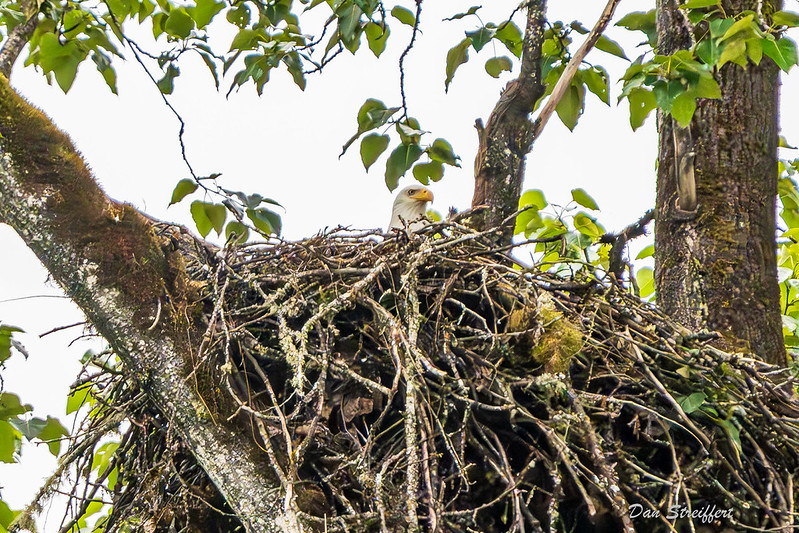
The vocalizations of the females of larger birds are often more obvious. Female Ospreys remain at the nest most of the day except for short “stretch” flights they take when the male arrives. A male will return to the nest several times a day with a fish which he drops into the nest. While watching Osprey nests, I have noticed that the female will be aware of the arrival of the male long before I notice them and she begins a loud mutual calling ritual between the paired birds. The female immediately takes the fish when the males drops it into the nest. She may take a few bites but soon tears off smaller pieces which she feeds to the young.
We are also more aware today of how males and females in some species pairs not only sing, but in some species such as the North American Barred Owls studied by Karan Odom, link parts of the song together. Like many bird species of the tropics, they share a two-part song and sing a duet with one bird completing a phrase sung by the other bird in the pair. Barred Owl males will sing a deep Who-cooks-for-you as the first part of the phrase and the female will often share repetitions of the for-you portion of the song.
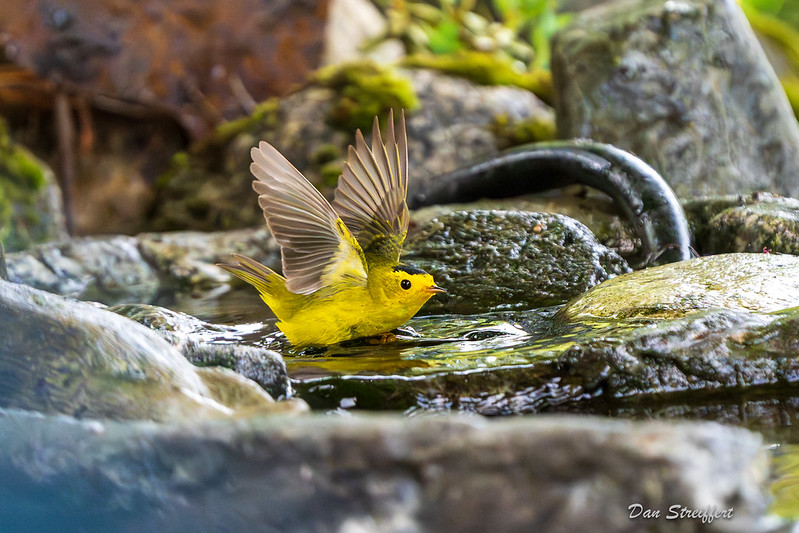
This updated focus on the songs of female birds has brought a freshness to birding. For example, where I was content to hear the song of a male Yellow Warbler and mark it as seen or heard on my daily checklist, I now wonder what the female Yellow Warbler song is like. The Galbatrosses recommend that birders take a little extra time to log the numbers of female birds and when possible tape record their songs.
Collecting such data is important for population studies and offers an important way average birders can document the presence and abundance of female birds on the landscape. Our hope is to have this kind of data from our marsh survey at the end of the year.
Andy McCormick writes for the Eastside Audubon Corvid Crier and has been previously published in Western Birds, Northwest Science, and the Heron Herald. Originally published in Malheur Musings, this article is reprinted here with permission of the author.